
Hi, I’m Ravikumar Vashi, a third year Computer Science student at the University of Victoria. Module 2 of EDCI 335 helped me think about learning in new ways. It showed me that how we design learning experiences has a big impact on whether they feel meaningful, confusing, or motivating. In this post, I connect my own experiences with the key ideas of backward design, design thinking, learning outcomes, deep versus surface learning, and project based learning.
Backward Design and Understanding by Design
Backward design is about starting with the end in mind. Instead of asking “What activities should we do in class?” it asks “What should learners know or be able to do by the end?” Once outcomes are clear, assessments and activities can be built to support those outcomes.
I saw the value of this in my algorithms course. From day one, our professor explained that the main outcome was learning to analyze and explain time complexity. This clarity made every practice exercise feel relevant. When we solved sample problems or prepared for exams, we knew exactly how those tasks connected to the bigger goal. In other courses where outcomes were not stated clearly, I often felt like I was just “doing the work” without really knowing why it mattered. Backward design helped me see the difference between meaningful and aimless tasks.
Resource: Understanding by Design overview from Edutopia
Design Thinking: Learning with Empathy and Iteration
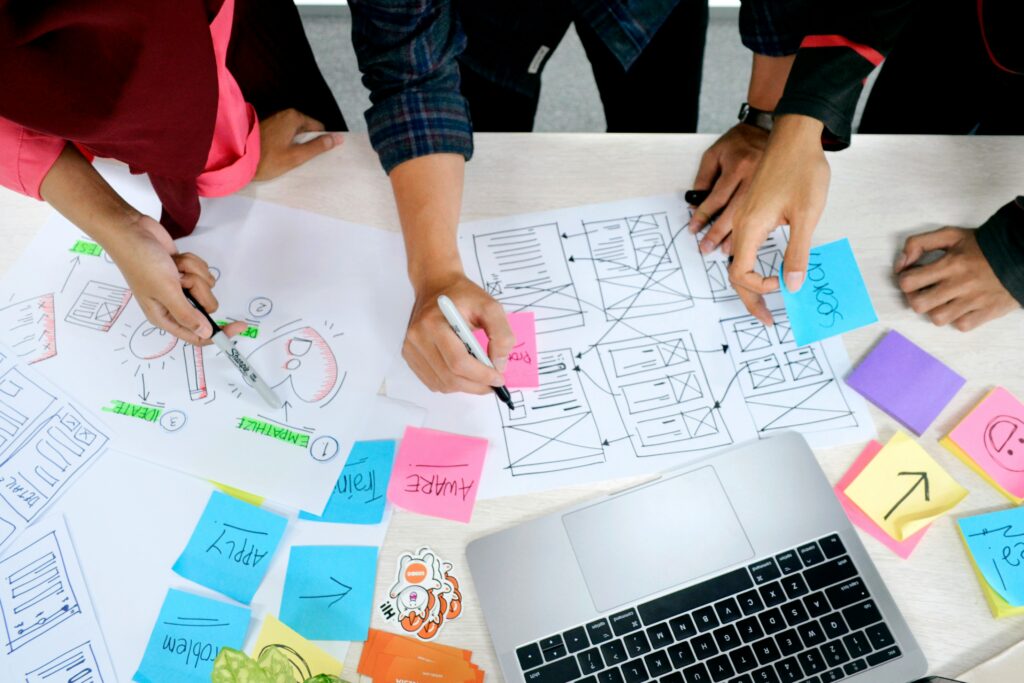
Design Thinking shifts the focus to learners and their needs. It encourages empathy, creativity, and iteration (in general). Instead of designing from assumptions, you listen carefully, build small prototypes, and adjust based on feedback.
In one of my group projects in SENG 310 course at UVIC, we were building an app for campus clubs. At first, my team wanted to add lots of advanced features like chat rooms and complex search options. But after interviewing students, we discovered that most people just wanted a simple tool to find upcoming events. That insight completely changed our design. We built a small prototype of an event listing page, tested it with real students, and improved it step by step. By the end, our app was simple but actually useful. This experience taught me that empathy and iteration often lead to better results than trying to design the “perfect” product from the start.
Resource: IDEO’s Design Thinking toolkit
Ethnography: https://www.interaction-design.org/literature/book/the-encyclopedia-of-human-computer-interaction-2nd-ed/ethnography
Learning Outcomes and Taxonomies
Clear learning outcomes make teaching and assessment fairer. Without them, it is hard to know if learning has happened. Module 2 introduced Bloom’s and SOLO taxonomies, both of which organize levels of learning.
I find Bloom’s taxonomy especially helpful because of its verbs like analyze, evaluate, and create. These verbs make it obvious what kind of work students should do.
- Weak outcome: “Students will understand Python.”
- Strong outcome: “Students will write and debug Python functions to solve real problems.”
The weak version is vague; how do you measure “understand”? The strong one is action based and clearly measurable. SOLO taxonomy is also useful when evaluating quality of responses, but for writing outcomes, Bloom’s feels more practical.
Resource: Bloom’s Taxonomy (Vanderbilt CFT) – PDF with verb lists and explanations Vanderbilt University
Surface and Deep Learning

This module also discussed the difference between surface and deep learning. Surface learning is about memorizing facts or repeating processes, while deep learning involves connecting ideas, applying knowledge, and thinking critically.
I have experienced both. In a statistics course, I often memorized formulas the night before a test. I could solve problems quickly, but once the exam was over, most of that knowledge faded away. That was surface learning. On the other hand, in my database systems course, I had to design a schema for a company. I had to apply normalization, justify choices, and think through possible problems. This task forced me to connect multiple concepts, and I still remember those lessons today. The difference was in the design deep tasks required me to use knowledge in meaningful ways rather than just recall information.
Inquiry and Project Based Learning

Inquiry and project based learning push students to explore questions and create real solutions. They are powerful because they mirror real life situations where answers are not always clear.
In my computer science studies, many projects follow this style. For example, when I worked on a machine learning project, the question was open ended: “Build a model to classify text.” There were many possible paths, so my group had to research, test, and decide what worked best. This kind of work motivated me because it felt authentic and creative. At the same time, I noticed challenges too. Without enough guidance, projects can feel overwhelming. The best projects I’ve done included both freedom and structure an open problem but also checkpoints, deadlines, and feedback along the way.
Resource: Project based learning overview from Edutopia
Closing Reflection
Module 2 taught me that good learning design is intentional. When outcomes are clear, when empathy drives design, when tasks are aligned, and when projects ask for real thinking, learners can move beyond memorization into lasting understanding. For me, the biggest lesson is that design matters as much as content. Going forward, I want to keep reflecting on how I learn and how I can apply these principles when I help others learn.